The Hyper-Graph.
Every identity, network path, workload and data store across AWS, OCI, GCP, Azure and Huawei Cloud as one graph that you can ask questions of.
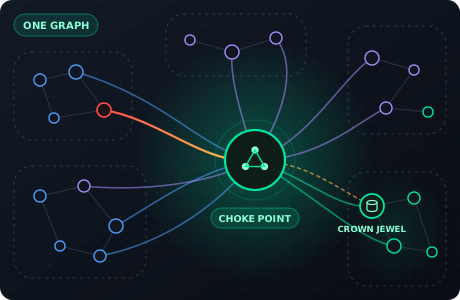
From five clouds to one answer
The Hyper-Graph is not an inventory list. It keeps the relationships, so the question stops being what you have and becomes what can reach what.
Read-only connectors
Connect each account with a scoped, read-only role, no agents. Arkhein reads resources, identities, policies and network paths from every provider you use.
One graph, five providers
Resources are merged by their canonical cloud identifier, so the same asset is never counted twice.
Graph Engine
Centrality ranks the nodes whose compromise matters most. Communities reveal blast-radius boundaries. Choke points show the few controls that cut the most attack paths.
Neural Mesh
Signals from every engine land on the same graph, so a vulnerability, a permission and an anomalous API call become one story.
Questions you can finally answer
Choke points, not checklists
Graph Engine ranks the few controls that cut the most attack paths, so the first fix is the one that matters most.
Needs: a completed scan of at least one account · Evidence: ranked choke points with the run id · Limits: reflects the last scan, not live drift (see Live Defense).
Blast radius you can see
Communities show where a compromise stops and where it keeps going, so you can draw boundaries before an attacker tests them.
Navigate by layer with Astrolabe
Move through the graph one layer at a time: internet exposure, identity, network, data.
Explore AstrolabeOne story per risk
Neural Mesh joins what separate tools report apart: the vulnerable package, the identity that can reach it and the API call that just touched it.
Answers about
the Hyper-Graph
An inventory lists what exists. The Hyper-Graph keeps how things connect, identities, permissions, network paths and data, so it can answer which assets an attacker can actually reach and through which path.
AWS, OCI, GCP, Azure and Huawei Cloud, merged into one graph by canonical cloud identifier.
It reflects the last completed scan. For changes as they happen, Live Defense streams cloud events onto the same graph.
A node or control that many attack paths must cross. Fixing it cuts those paths at once, which is why Graph Engine ranks choke points first.
No. Each account connects with a scoped, read-only role. The first scan builds the graph and Graph Engine ranks its choke points.
Ready to see your cloud
as an attacker does?
Book a demo and our team will walk you through Arkhein on your own cloud.