Code Security
Scan your repositories for infrastructure-as-code issues, code flaws, secrets and vulnerable dependencies, and see which cloud resource each one becomes.
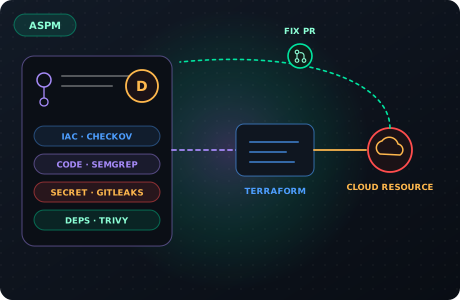
From code to cloud
Every finding in a repository can be followed to the resource it provisions, and fixed where it was written.
Connect repositories
Discover and connect repositories from GitHub, GitLab and Azure DevOps.
Four engines
Checkov for infrastructure as code, Semgrep for code, Gitleaks for secrets and Trivy for dependencies.
Code to cloud
Terraform in the repository is linked to the cloud resources it provisions, so a cloud finding points to the file, line and commit behind it.
Fix by pull request
A remediation pull request is opened in the repository that owns the code.
One graph from commit to cloud
Health grade per repository
Each repository gets a grade from A to F based on its findings; an unresolved secret caps it at D.
Context from the cloud
A code finding that provisions an exposed resource ranks above the same finding in a module nobody deploys.
Open-source engines
Checkov, Semgrep, Gitleaks and Trivy run out of the box, with no extra licence.
Autonomous Resolution
Fixes land as pull requests in your pipeline, and your approval policy decides what merges.
Explore Autonomous Resolution
Answers about
code security
GitHub, GitLab and Azure DevOps.
Infrastructure as code (Checkov), application code (Semgrep), secrets (Gitleaks) and dependencies (Trivy).
From the number and severity of open findings; any unresolved secret caps the grade at D.
No. It opens the pull request; your approval policy decides what merges.
Ready to see your cloud
as an attacker does?
Book a demo and our team will walk you through Arkhein on your own cloud.