Serverless Security
See every function you run, the role it acts with and the vulnerable dependencies inside its code.
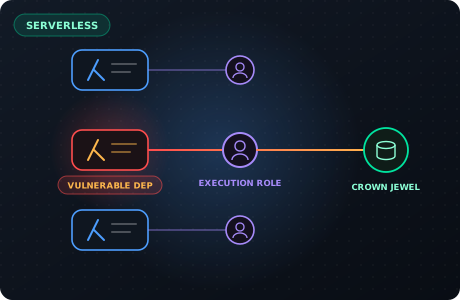
From function to what it can reach
Functions are small, many and short-lived; Arkhein keeps them on the same graph as the rest of your cloud.
Inventory
Functions such as AWS Lambda are listed with their runtime, handler, memory and execution role.
Scan the code
The function's code package is scanned with Trivy for known vulnerabilities in its dependencies.
Follow the role
The execution role links the function to everything it can reach on the Hyper-Graph.
Prioritise
A vulnerable function whose role reaches sensitive data ranks above the same dependency in an isolated function.
No server, still a risk
Code and permission together
A vulnerable dependency matters most when the function's role can read or change something valuable.
Every function, one list
Runtime, role and findings for each function in one place, filtered by provider.
Least privilege for functions
Over-broad execution roles show up like any other identity on the graph.
Explore CIEMHyper-Graph
Functions sit on the same graph as identities, networks and data.
Explore the Hyper-Graph
Answers about
serverless security
Its name, runtime, handler, memory and execution role, plus the vulnerabilities found in its code dependencies.
The function's code package is scanned with Trivy against known vulnerability data.
Because an attacker who exploits the function acts with that role; the graph shows what the role can reach.
Ready to see your cloud
as an attacker does?
Book a demo and our team will walk you through Arkhein on your own cloud.